
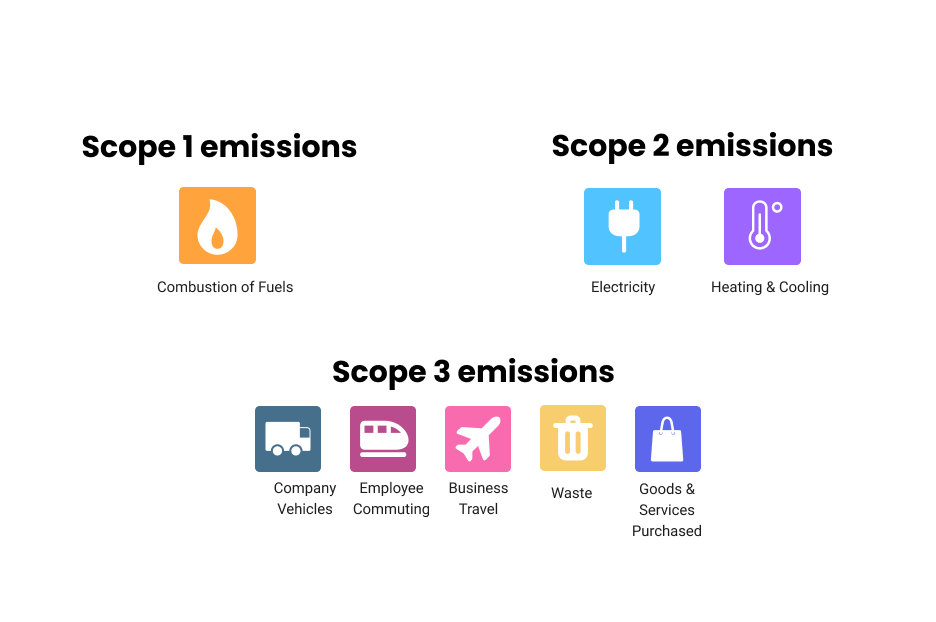
Businesses cause carbon emissions in many different ways. Some of these are direct – they happen on their site, and some are less direct but still real. For example, if your employee takes a taxi on expenses during a work trip. The emission didn’t come directly from your business, but it was the activities of your business which led to it happening. That’s why emissions reporting for business is broken down into three different scopes; Scope 1, Scope 2, and Scope 3. These range from direct emissions from your site (scope 1), emissions from the energy you purchase (scope 2), and indirect emissions across your supply chain (scope 3). We’ve broken down each scope so you can understand what kind of emissions fit where.
Scope 1 Emissions:
Scope 1 emissions refer to direct greenhouse gas emissions produced from sources that are owned or controlled by an organization. These emissions are generated from activities such as burning fossil fuels, manufacturing processes, and transportation within an organization’s operational boundaries. Examples of Scope 1 emissions include emissions from company-owned vehicles, on-site fuel combustion, and emissions from industrial processes.
The combustion of fossil fuels, particularly coal, oil, and natural gas, releases significant amounts of carbon dioxide (CO2), methane (CH4), and nitrous oxide (N2O) into the atmosphere. These gases are the primary drivers of global warming and climate change. By actively measuring and managing Scope 1 emissions, organizations can take responsibility for their direct contributions to climate change and implement strategies to reduce them.
If you don’t burn any fuels on your site, your business may not have any scope 1 emissions. But remember, a gas boiler for heating is combusting fossil fuels, so would be scope 1 if you own the premises.
Scope 2 Emissions:
Scope 2 emissions encompass indirect greenhouse gas emissions resulting from the consumption of purchased electricity or heat by an organization. These emissions are produced off-site but are associated with the energy consumed by the organization. Examples of Scope 2 emissions include the electricity used to power office buildings, factories, and other facilities.
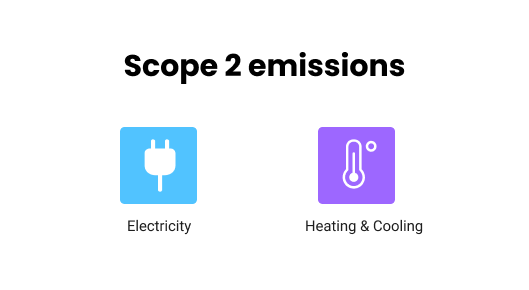
The electricity generation process often involves the burning of fossil fuels, predominantly natural gas, which release greenhouse gases into the atmosphere. Although Scope 2 emissions occur outside an organization’s direct control, they are considered a significant component of an organisation’s carbon footprint. To mitigate Scope 2 emissions, organizations can transition to renewable energy sources, such as wind or solar power, or reduce their consumption of energy by increasing efficiency and reducing waste.
Scope 3 Emissions:
Scope 3 emissions account for the indirect emissions produced throughout an organization’s value chain, including activities outside its operational boundaries. These emissions result from sources that are neither owned nor controlled by the organization but are influenced by its activities. Scope 3 emissions are typically the most substantial and challenging category to measure, as they encompass a broad range of activities.
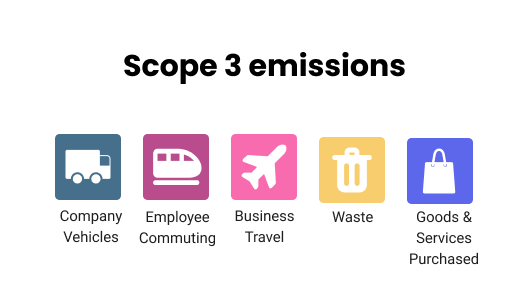
Examples of Scope 3 emissions vary across industries and may include emissions from purchased goods and services, transportation and distribution, waste disposal, employee commuting, business travel, and product use. For instance, a manufacturing company may have Scope 3 emissions associated with the extraction of raw materials, the manufacturing process itself, and the disposal of the final product. Similarly, a retail company may have Scope 3 emissions from the transportation of goods and the energy consumed by customers using their products.
Even if your business sells a service and not a physical product, you will still have some scope 3 emissions, such as the energy required to run servers in the cloud.
Addressing Scope 3 emissions requires collaboration and engagement with suppliers, customers, and other stakeholders throughout the value chain. Scope 3 emissions can be tricky to shrink because you have less control over them, but you can help encourage change by engaging with your supply chain or switching to more sustainable suppliers.
Tracking your emissions
Tracking your emissions in scope 1 is fairly straightforward, you just need to work out how much fuel you burn on site. Scope 2 is a bit harder, but it’s scope 3 where it gets really complicated. If you were to do it manually, you’d have to contact every single supplier of everything you’ve ever purchased as a business and try to get information on their carbon footprint. (Something they themselves might not have). Don’t let that put you off though. Rather than wasting vast amounts of time and resources on a manual process, we’ve developed Tred Insight to make working out your business’s carbon footprint effortless, and it gives you a breakdown across scope 1, 2 and 3 emissions.
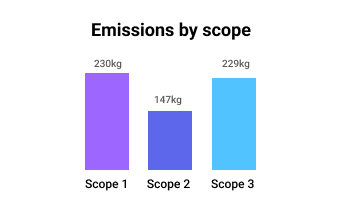
Tred Insight leverages open banking to establish a secure connection to your business bank account, then our carbon tracking tech takes that data and uses it to work out your carbon footprint automatically in just minutes. If you’d like to be among the first to try Tred Insight, sign up for our waitlist today.


0 Comments