
Climate change is a scary subject. We’re on track for dangerous levels of warming that will drastically change the environment and lead to a cascade of terrible outcomes; droughts, hurricanes, forest-fires, floods and all kinds of extreme weather events. There’s no sugar coating it, climate change is here, it’s real, and if we don’t drastically reduce global emissions things are set to get a whole lot worse.
It would be naïve to only focus on good news about climate change, but similarly it can be demoralising to focus only on the bad. Despair is a natural reaction, but despair won’t solve climate change.
We decided to showcase some big trends and stories that show that whilst there’s still so much to do, real progress is being made and with further effort, we really can slow and ultimately halt climate change.
1. The renewables revolution
Over the past decade the cost of generating electricity from renewable energy sources has tumbled. It’s hard to emphasize how important this change is. The cost of installing solar panels has gone from being the most expensive energy source to considerably cheaper than any other fossil fuel-based energy source.
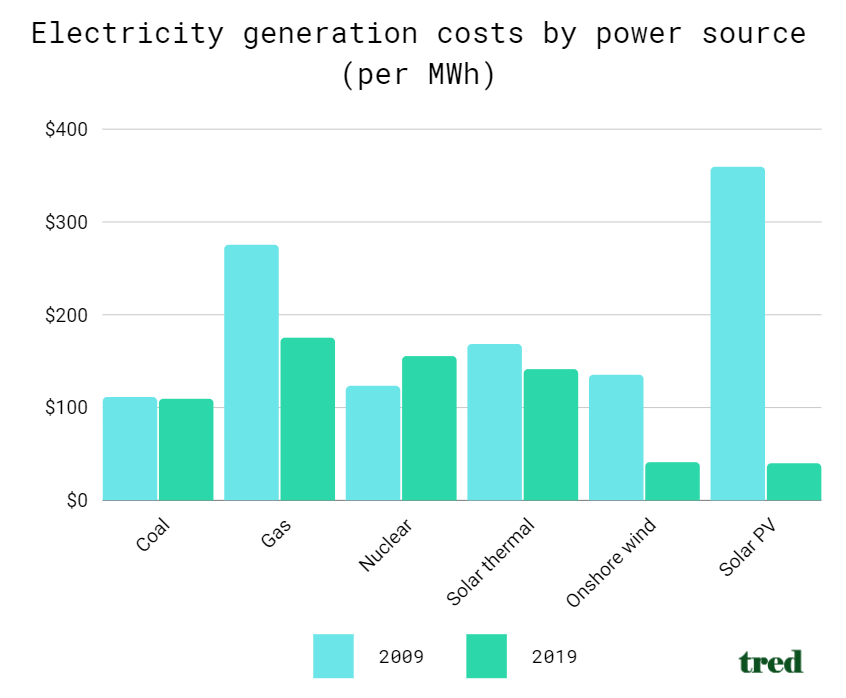
Data Source: My World in Data
This is a huge leap, but this trend still has further to run. Now that renewables are far cheaper than they were 10 years ago, far more of them will be installed. This in turn means greater economies of scale, leading to lower prices in a virtuous circle. There’s even a term for this phenomenon, ‘
With new solar capacity now cheaper than coal (previously the cheapest electricity source) in many parts of the world, it’s inevitable the total amount of solar capacity installed will rise drastically, meaning even lower prices. This means countries can switch rapidly over to this cheaper energy source, leading on to the next piece of good news on the climate front…
2. The collapse of coal
Coal is the single biggest cause of climate change, accounting for 25% of global greenhouse gas emissions (oil is close behind on 21%, followed by natural gas on 19%). Kicking coal is among the most effective of all ways to reduce the planet’s emissions.
The good news is that there is now real progress being made on phasing out this dirtiest of fossil fuels. Planned construction for new coal plants is being reconsidered, and the total pipeline of new coal power plants planned to be built in the coming decades is collapsing rapidly.
In 2019 India had plans to build 150 Gigawatts of new coal plants, which is many hundreds of new coal power stations. In 2020 that pipeline of planned coal plants was cut back by a whopping 86%, meaning that Indian’s coal capacity will go from a planned doubling to barely increasing at all.
Here’s a remarkable detail buried in @IEA #WEO20
India will build 86% less new coal power capacity than expected last yr
Long seen as driving global coal growth, IEA now says India will add just 25GW by 2040
The result? Global coal capacity will fall.https://t.co/bt7QfouTAf pic.twitter.com/SUDlaMo8so
— Simon Evans (@DrSimEvans) October 15, 2020
What we really need of course is for it to shrink, but this is a big step in the right direction. This single move from India means that global coal capacity will start to fall, as reductions in coal generation in more developed economies will no longer be countered out by big increases in India and elsewhere.
In another piece of truly game-changing news, China recently announced it will halt its funding of over-seas coal projects. As China was by a long way the largest financier of coal power projects around the world, this will have a big impact on the ability of coal project to get financing and should drastically cut back the pipeline of future power plants. The move looks likely to cancel the construction of 44 planned coal power plants that had planned to be financed with Chinese loans. This will prevent the emission of around 250 million tonnes of CO2 per year, which is approximately equivalent to the total emissions of France. (Source: Centre for Research on Energy and Clean Air)
3. Electric cars go mainstream
The transition from petrol and diesel to electric cars is getting underway. The world’s most valuable car company (Tesla) sells only electric vehicles, and in the UK we seem to have reached an inflection point, with a tripling in the % of new car sales that are electric in just the last two years. That’s a rapid change, and hopefully an indication of more to come.
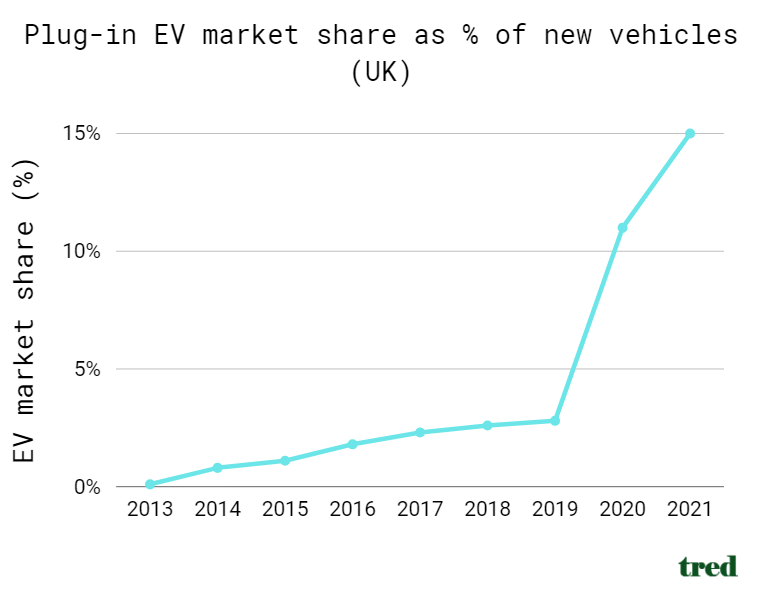
Data Source: Vehicle licensing statistics
In Norway, electric cars now make up over half of all new cards sold. If present trends continue, almost all new car sales in Norway will be electric this year. The country is on track to ban the sale of new petrol and diesel cars by 2025.
The UK is a few years behind Norway, so could be doing better, but its plan to ban the sale of all new petrol and diesel cars by 2030 shows which way things are headed. The list of countries set to ban internal combustion engine cars is extensive and growing by the month.
Here’s all the countries that have announced a ban so far:
| Country | Year they will ban sales of petrol and diesel cars: |
| Norway | 2025 |
| Denmark | 2030 |
| France | 2040 |
| India | 2030 |
| The Netherlands | 2030 |
| Spain | 2040 |
| Sweden | 2030 |
| Germany | 2030 |
| Ireland | 2030 |
| Slovenia | 2030 |
| Singapore | 2040 |
| Sri Lanka | 2040 |
| Israel | 2030 |
| Iceland | 2030 |
| United Kingdom | 2030 |
Source: Wikipedia
It’s becoming clear that the writing is on the wall for petrol and diesel cars. A rapid shift to electric vehicles is underway, and thanks to the falling cost of renewables it will be easy to power them with abundant clean energy.
4. Green steel is here
Steel is an essential material – from buildings to cars, it’s used to build so much of the modern world. It is also made almost exclusively by burning coal to heat blast furnaces, and therefore is a big cause of carbon emissions. In fact, the production of steel is responsible for around 7% of all carbon emissions, which is more than four times the entire emissions of the aviation industry.
Until recently, there’d been no way to make steel without using coal, but new breakthroughs mean there’s now the option of clean steel made from hydrogen. A pilot project in Sweden called Hybrit has used a combination of a hydrogen-fuelled furnace and an electric arc furnace to create the world’s first ‘green steel’ that causes 90% lower carbon emissions than making steel in the traditional way in a coal-fired furnace.
Unlike coal, hydrogen only emits water vapour when burned and can be made using renewable electricity via hydrolysis. The pilot plant produced around 1 tonne of green steel per hour, but there are also plans in the works for a commercial plant to drastically increase production.
This breakthrough means there’s a way to drastically reduce emissions in a hugely polluting section that accounts for a big chunk of the world’s emissions. Steel was previously thought to be one of the hardest sectors to decarbonise, but now there’s a clear route to doing so. Now we just need the roll-out to accelerate.
5. Storing clean power just got easier
The cost of renewable energy is falling drastically, which is fantastic news. But to roll-out renewables to take on a really big chunk of the energy grid, they also need to be complemented with lots of storage capacity. That’s because unlike a coal, gas or nuclear plant, most renewables are intermittent, and only generate energy when the wind is blowing, or the sun is shining.
A lack of affordable energy storage could easily be a serious blocker to increase renewable capacity, but recently we’ve seen some big breakthroughs in this area that could see that barrier removed.
Until now lithium-ion batteries have been the go-to technology for storing power, but although these are great for powering laptops or electric cars, there not a good option for providing large amounts of back-up power to the grid to balance intermittent renewables. The reason for this is simple- they’re too expensive.
But Form Energy, a new battery start-up, may have just the solution; a new, drastically cheaper battery designed for the grid. Rather than using Lithium-ion batteries which are expensive, Form energy has developed iron-based batteries that are vastly cheaper. Their battery uses iron as a cathode and air as an anode in a process called reversable rusting. Form say they’ll be able to get energy storage costs down to $10/kWh, which is a huge drop on the current $143/kWh storage costs for Lithium-iron batteries. With storage costs that low it’ll be easy for cheap renewable power with storage to back it up to totally displace fossil fuels, cleaning up the energy grid and cutting carbon emissions.
6. The world’s biggest direct air capture plant has turned on
Direct air capture means pulling carbon dioxide directly from the air and then storing it underground. It’s the holy grail of carbon removal technologies.
In September 2021 the world’s largest direct air capture plant turned on and started extracting carbon from the atmosphere. It’s called Orca and it will capture 4,000 tonnes of CO2 per year and store it safely underground where it will remain for thousands of years. Here how it works:
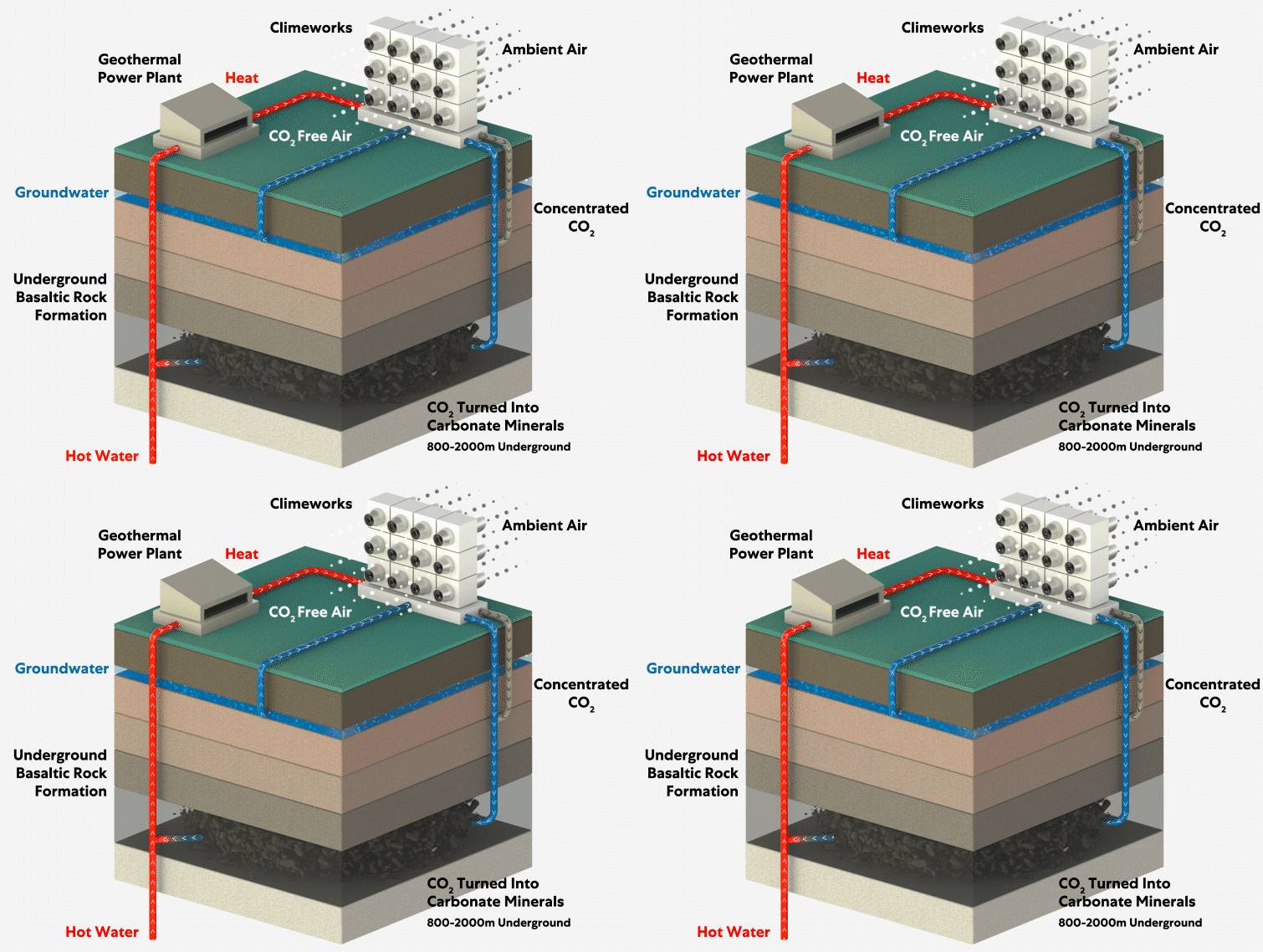
Image credit: Climeworks
This technology does not yet have the potential to truly address the climate crisis, so it is no silver bullet. The Orca plant captures CO2 at a cost of $1,200 per tonne, which is far too expensive to be able to make a big difference to global emissions. However just as we’ve seen the cost of solar panels come crashing down over the last few decades, hopefully this demonstration plant is the first step to getting costs drastically down and creating an economically viable way of capturing large amounts of CO2. Let’s not bet on this technology to save our bacon, but it’s exciting to see the tentative first step to large-scale carbon removal from the atmosphere.
7. The world’s biggest emitter has pledged to get to net-zero
China is the world’s biggest emitter, and responsible for more emissions than the United States and the European Union combined. Any actions China takes have a huge impact on global emissions. In potentially the biggest news of 2020 that you never heard about at the time, China pledged to go carbon neutral by 2060, joining the ever-growing list of countries that have committed to go net-zero by mid-century as part of the Paris Agreement. A paper published this year showed that this target, provided it is met, will mean China will be playing its fair share in meeting Paris Agreement’s pledge to keep temperature rises to 1.5oC.
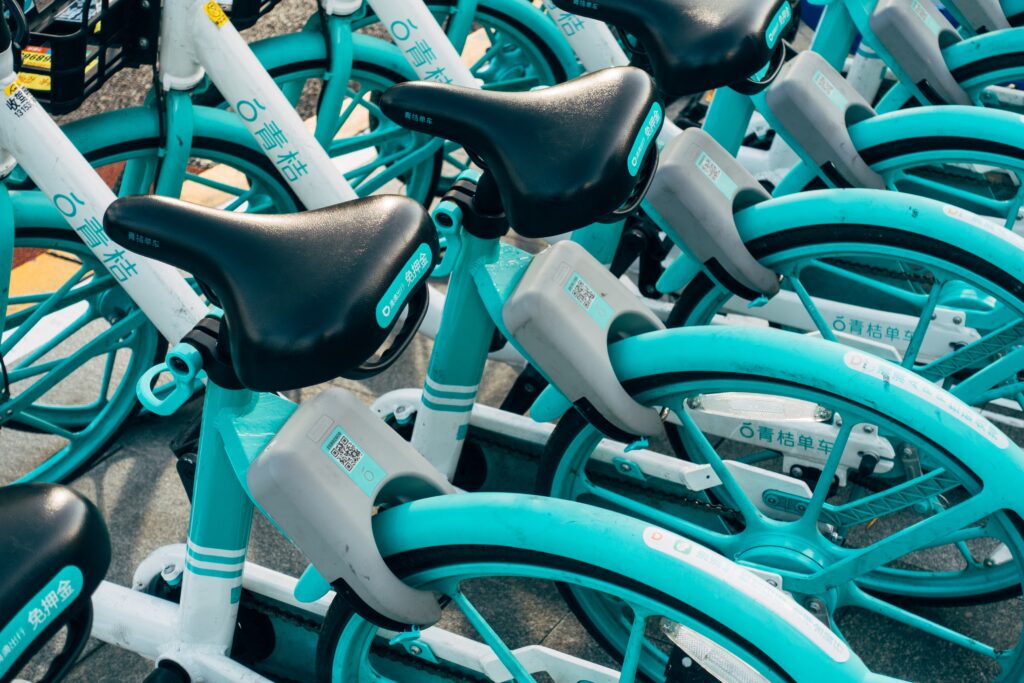
China may be a big emitter, but it’s also leading the world in green technology. China is home to half the world’s electric cars, 98% of the world’s electric buses and 99% of its electric bikes.
It’s got a long way to go, but China being on the path to net-zero is a hugely positive news story in the world’s effort to fight climate change.
8. Next-generation geothermal could provide a whole new source of renewable energy
The shift away from fossil fuels will require switching all sorts of technologies over from burning fuel to running on clean electricity. We’ll need to produce lots more renewable energy to power all these new electric cars, heat-pumps, and green steel foundries. More wind and solar can provide a lot of this thanks to their falling costs, but to provide round-the-clock baseline electricity there’s a previously over-looked source of renewable power that could be drastically scaled up in the next few years – geothermal.
Geothermal is a renewable energy source where the heat of the earth is used to generate energy. The heat turns water into high-pressure team, which is then used to drive turbines to make electricity.
Current geothermal technology requires the right geology, and can only be built in areas where geothermal heat is close to the surface, so it is great for countries like Iceland, which happen to have lots of geothermal heat in the right places (Iceland generates 30% of its electricity from geothermal power) but doesn’t work in most areas of the world.
New techniques for accessing geothermal energy which are being developed by start-ups like fervo energy and Eavor, mean that geothermal energy could be tapped into virtually anywhere.
Closed-loop geothermal systems currently in development work in any underlying geology, so finding the right location will no longer be a barrier to scaling-up.
The ability to build these plants wherever they are needed opens a truly huge resource. Just 0.1% of the heat content of Earth could supply humanity’s total energy needs for 2 million years, and it’s constantly being replenished by the decay of radioactive elements in earth’s core, so it will never run out.
With these new technologies currently being tested, geothermal energy could be scaled up to produce reliable, baseload power at a lower cost than fossil fuels, making it an absolute game-changer for decarbonising electricity grids. This tech still has further to go, so it doesn’t mean we can slack off our other climate efforts, but it’s exciting to see a bright future for more forms of renewable energy.
9. Heat pumps are coming to clean up our boilers
Heating buildings is a big source of carbon emissions. Generating heat accounts for 37% of the UK’s carbon emissions, making it the biggest emitting sector of all. Of that the biggest chunk is space heating, which itself accounts for 17% of emissions.
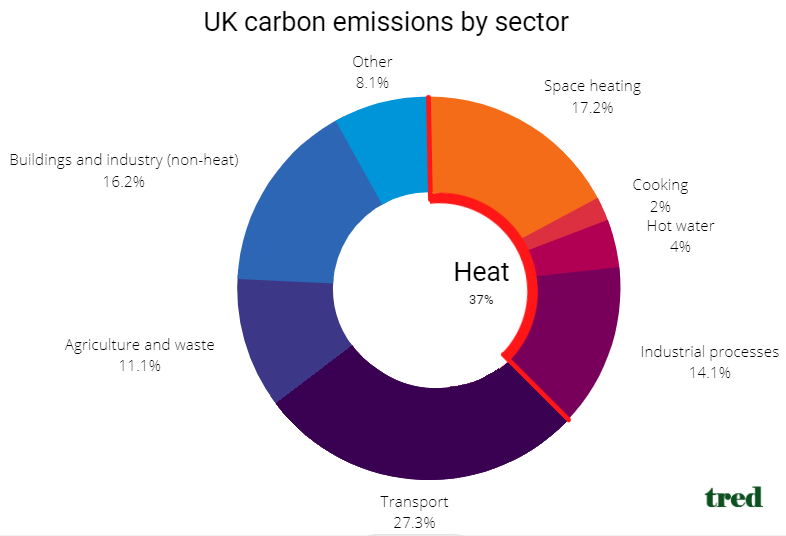
Data Source BEIS UK Greenhouse Gas Emissions 2019
In the UK most space heating is done by gas boilers. These provide heat at lower cost than using electric heating, but because natural gas is a fossil fuel, they generate a lot of carbon emissions.
Decarbonising heating until recently seemed like it’d be a near-impossible problem because electric heating requires so much energy that it would foist huge cost increases on consumers to switch from gas to electric heating.
Heat pumps solve this problem by delivering a heating system many times more efficient than electric heating, allowing it to be competitive with gas on price but without having to burn any fossil fuels. As the graph below shows, heat pumps are miles ahead of other heat sources in terms of how low their emissions are.
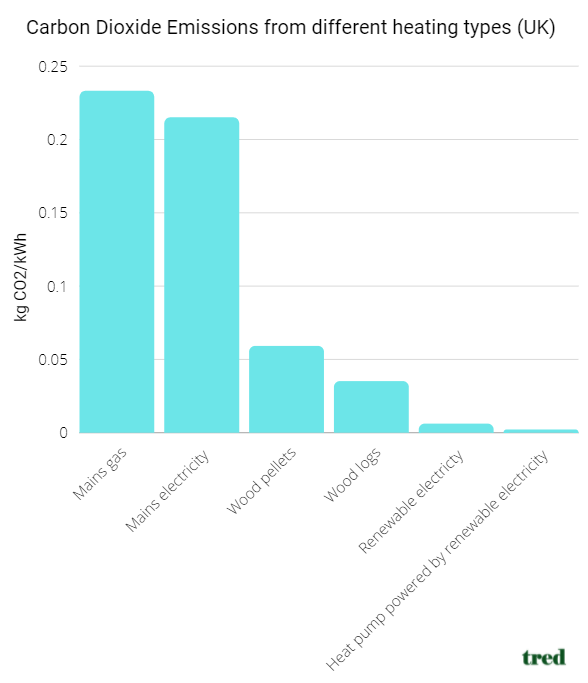
Data Source: SAP emissions factors
Heat pumps are getting more efficient, and costs are coming down. As adoption increases and they become more common, prices will reduce further. Although still expensive to install, they are forecast to halve in price in the coming years. This opens up a realistic route to decarbonising heating, removing a big chunk of our emissions.
10. We’re discovering new ways of absorbing carbon
Here’s the bad news: Humanity has not acted fast enough on cutting emissions. We knew climate change was real in the early 90s, and since then global emissions have only gone up. We’re on course to over-shoot on our emissions and therefore likely to cause global temperatures to increase more than 1.5oC.
Now here’s the good news: We can absorb that carbon we’ve already emitted and take it back out of the atmosphere, so it stops warming the planet. The term for how this is done is ‘Negative Emissions Technologies’ and they’re now a big part of our climate models and emissions targets.
There are many different negative emissions technologies, from biochar to building with biomass. All involve carbon being removed from the atmosphere and then stored safely for the long term.
One promising negative emissions technology that could make a big impact in future has the very dull sounding name of ‘enhanced weathering’. But don’t let that put you off, enhanced weathering could be a key weapon in the fight against global warming.
Enhanced weathering means getting rocks to absorb carbon. Many types of rocks naturally absorb carbon, and this process absorbs around 3% of global fossil fuel emissions. But this natural process can be sped up dramatically. Smashing up rocks makes them absorb carbon much faster, and spreading the resulting rock-dust onto farms means microbes in the soil speed up the chemical reactions that absorb the carbon.
Pulverising rocks bypasses the slow weathering action, and spreading the resulting powder on large areas of agricultural land makes use of microbes in the soil to speed up the chemical reactions. This also adds minerals to the soil, benefiting the crops.
Enhanced weathering could absorb up to 3.7bn tonnes of CO2 per year globally, and one start-up called Project Vesta has recently secured funding for pilot projects to test how effective enhanced weathering can be at absorbing CO2.
11. Countries are switching planes for trains
Flying is a major cause of carbon emissions, and especially for frequent flyers it makes up a big chunk of people’s carbon footprints. Electric trains however are a far, far more sustainable way of getting around, as their emissions per passenger mile are much lower.
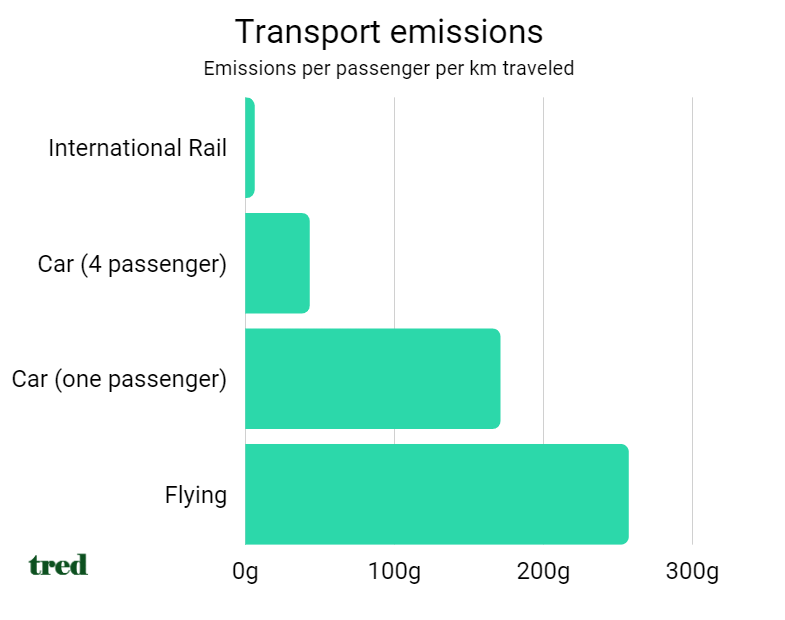
Data Source: BEIS greenhouse gas conversion factors 2019
The difference is huge. Efficient electric trains emit 6g of CO2 per passenger per mile Vs over 250g for planes. That means flying is 41 times more polluting than going by train!
The good news is that lots of countries are starting to wake up to the need to get travellers to switch the plane for the train. This year France banned domestic flights on routes that can be travelled by train in two and half hours or less. Across Europe, night trains are making a comeback as passengers are switching away from planes. In Austria the national carrier has stopped running domestic flights from Vienna to Salzburg and instead partnered with the national rail operator to run regular trains on the route. High speed rail could replace planes on many more routes with the right mix of incentives and consumers making environmentally conscious choices.
12. Tred is coming to make it easy to cut your carbon footprint
Switching planes for trains is just one way you can make smarter choices to reduce your carbon footprint. There are so many simple switches you can make that can drastically reduce the emissions you cause, often without costing more. Understanding your carbon footprint in real-time is key to making smarter decisions, and that’s exactly what Tred does.

If you’d like to use Tred to reduce your carbon footprint, we’re about to launch our Beta. You can sign up to be on the waiting list for early access today.



I would combine using all three Natural energy resources be happy in using Rain water, wind and solar power energy that is what I am planning to do go totally off grid living and become 100% percent greener in Energy efficiency