

We are so passionate about climate change that we love having a deep dive from time to time explaining exactly how emissions are causing global temperature changes. That might not be for you – but if you want to really understand what greenhouse gases are, how they work, and which are most important, then this is the article for you! In this article we’re going to talk about –
- What sort of light does the Sun emit?
- What types of light cause the earth to warm?
- Why doesn’t the earth just cool down?
This is a bit of complicated question and requires us to talk about a few things before we dive in.
How does the sun heat the earth in the first place?
The sun emits light (who knew!) This is across a wide range of energies but in the main this is ultraviolet, visible or infrared light. The Earth’s atmosphere is transparent to most visible light, and so lots of light from the sun makes its way through the atmosphere and is absorbed or reflected off the earth. How much light is reflected off the earth is called the albedo – the earth reflects around 30% (albedo = 0.3) of the light that shines on it, while the moon reflects around 12% (albedo 0.12). Earth’s upper atmosphere filters out much of the harmful ultraviolet light from the sun (this is done predominantly by ozone, which is why holes in the ozone layer are so bad).
As this light hits the earth it doesn’t just get stored or reflected – it gradually gets re-radiated as infrared light which we feel as heat. If you’ve ever stood on tarmac on a summer’s day, you’ll feel the light from the sun hit the tarmac, warm it up and then emit it back upwards and you’ll feel warm. There is this idea of a ‘black body’ in science, which is where an object of a certain temperature will have a profile of the sorts of light that it emits. Hot objects emit light with higher energy (a flame can look yellow or blue) while cooler objects emit light at lower energy (tarmac on a sunny day).
This infrared light isn’t emitted straight back out of the atmosphere though – it’s constantly emitted and reabsorbed by the air around us until it reaches the edge of our atmosphere where it is then radiated into space. You can think of Earth’s atmosphere as a sort of one-way mirror – light is allowed through from the sun, but is kept in by being constantly reflected and reabsorbed. This is why the Earth has a steady temperature and it doesn’t become really cold at night (the moon, which has no atmosphere, experiences temperatures up to 120°C during the day and -130°C at night).
When the earth absorbs the same amount of energy from the sun as it emits back into space then it’s will neither heat up or cool down – it’ll stay at a (relatively) constant temperature. If you’ve ever seen a thermal camera pointed at someone you’ll see their face is hotter than the rest of their body – this is because their clothes are stopping the infra-red radiation from escaping, and so appears cooler. Interestingly we know global warming is happening because the upper atmosphere of the Earth is cooling because heat is being trapped lower down – for this and other climate modelling Syukuro Manabe, Klaus Hasselman and Giorgio Parisi won the 2021 Nobel Prize in Physics.
These two factors (reflectivity and the insulating properties of the atmosphere) can trigger other feedback effects such as increased water vapour, lower cloud cover and methane clathrate melt which further increase the rate at which the planet warms. However – we want to talk about what makes a greenhouse gas so we’ll focus on this.
What are the main factors in a greenhouse gas?
How bad a gas is for climate change depends on a few factors –
- How do greenhouse gases absorb heat from the earth?
- How do greenhouse gases absorb trap this heat?
- How resistant are greenhouse gases to being broken down in the atmosphere?
Let’s tackle these one by one!
How do greenhouse gases absorb heat from the earth?
When scientists show light spectra they are plotting the intensity of the light at a given energy. In the following graph this is plotted as flux (i.e the amount of light being emitted) vs. frequency (literally the number of waves a light does for a given distance, for example 1,000 cm-1 would mean the light completes 1,000 waves per centimeter). So here’s what the earth would look like from space (if nothing in the atmosphere absorbed light) –
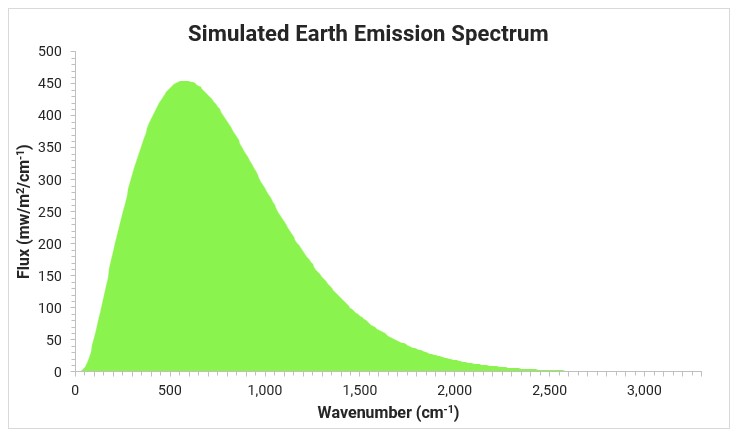
Absorbances in the 100-400 cm-1 range are generally not considered important for climate change – the reason being that these are quite low energy frequencies and not many molecules actually absorb light very effectively here. Therefore, we can observe the key frequencies are those between about 400 cm-1 and 1300 cm-1. Carbon dioxide especially absorbs a lot of light at around 670 cm-1 – making a potent greenhouse gas. It’s also stable so it hangs around in the atmosphere for a long time.
What sort of light do greenhouse gases absorb?
Let’s have a look at the spectra of a black body with some common absorbances laid over the top –
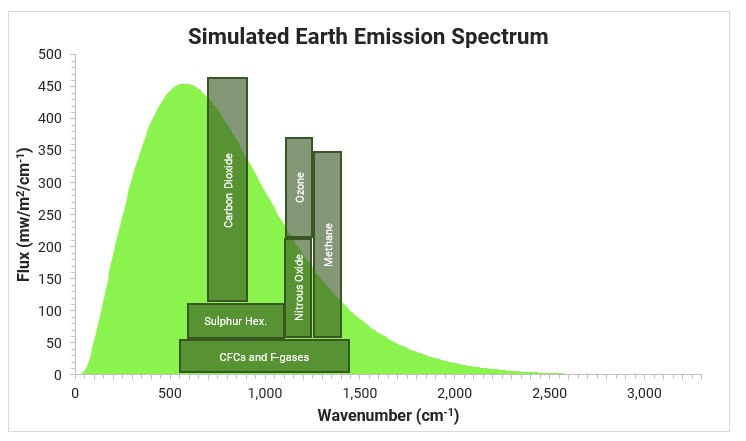
The seven greenhouse gas compounds specified in the Kyoto protocol are –
- Carbon dioxide (broad absorption at 620 cm-1)
- Methane (lots of absorptions around 1300 cm-1)
- Nitrous Oxide (N2O) (absorbs at 592 cm-1, 1275 cm-1 and 1302 cm-1)
- F-gases (i.e. flouro-carbons) (generally quite a few absorbances between 600 and 1300 cm-1)
- Chloro-flouro-carbons (CFCs) (generally quite a few absorbances between 600 and 1300 cm-1)
- Ozone (broad absorption around 1020-1070 cm-1)
- Sulphur Hexaflouride (SF6) (615 cm-1, 775 cm-1, 948 cm-1)
So you can see that all the greenhouse gases absorb light in just the right place to trap heat within the Earth’s atmosphere. A minor wrinkle here is that some of these gases absorb infra-red radiation very strongly, while others absorb it more weakly.
How do greenhouse gases trap this heat?
All of this is well and good but I haven’t told you why these gases absorb heat. Molecules can absorb energy in lots of different ways but the main ways are electronic (where electrons change how they move around the atoms in the molecules, not really relevant for global warming), vibrational (how the molecules twists, turns and bounces), rotational (how it tumbles in the air) and translational (how fast it’s moving around). Without getting too bogged down in the detail, molecules will absorb infra-red light mainly as vibrational and rotational energy. If you want you can see some of the ways that carbon dioxide, sulphur hexaflouride and ozone vibrate when they absorb energy.
What a molecule absorbs and how strongly it absorbs isn’t the only thing that makes something bad for the planet. How long it takes for this gas to break down in the atmosphere is also important – and it’s between absorption and lifetime that we begin to approximate a measure called “Greenhouse Warming Potential” (GWP). GWP attempts to describe how much heat a gas absorbs vs carbon dioxide. So if a gas absorbs a lot of infra-red radiation in comparison to carbon dioxide and sticks around for a long time, it will have a high GWP (for example, sulphur hexafluoride has a GWP of 24,000 which means 1kg of sulphur hexafluoride is as bad as emitting 24,000 kg of carbon dioxide).
Which greenhouses gases last a long time?
What makes a gas stick around in the atmosphere for a long time? It’s a couple of things…
- Resistance to reaction with gases in the atmosphere (mainly oxygen)
- Resistance to being broken down by light
Carbon dioxide doesn’t react with oxygen or react with light – it’s what is called a thermodynamic sink. You won’t release energy by transforming it into any other compound under any reasonable atmospheric conditions. That means CO2 stays around in the atmosphere for a very long time, as it doesn’t break down further. In contrast, methane reacts with ozone high in the atmosphere relatively quickly to produce carbon dioxide and water, staying in the atmosphere for a short time.
It becomes fairly straightforward to compare how much each of these gases is warming the globe using this model – 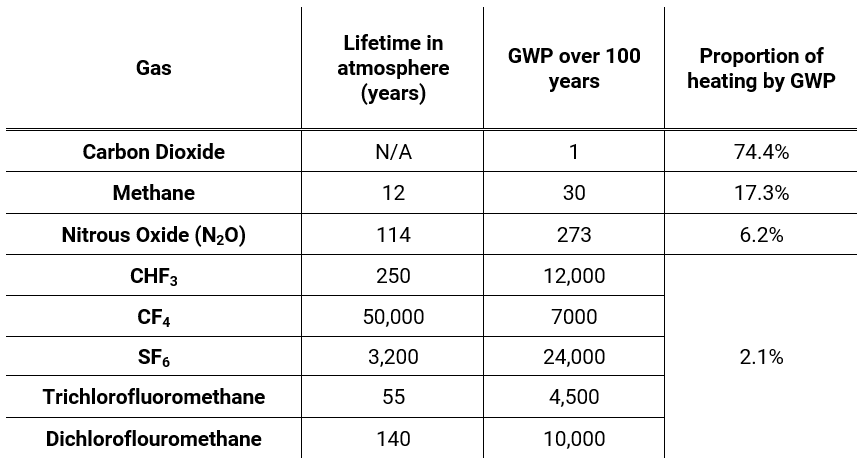
From this we can see that preventing methane emissions would have a fast and significant impact on the amount of warming in the atmosphere. Next should be eliminating Nitrous Oxide simply because of it’s high GWP and relatively low proportion of emissions – the main source of this is in agricultural practices.
But because carbon dioxide is the most emitted greenhouse gas by far, the story is still the same – we must reduce our carbon emissions to reduce atmospheric heating and avert the climate catastrophe. It’s not the most potent greenhouse gas, but it is the most important, accounting for 74% of emission’s global warming potential.
So there you have it! Greenhouse gases absorb heat from the earth and prevent it from being radiated into space.
That’s where Tred comes in. We designed Tred to help you shrink your carbon footprint. By tracking your emissions effortlessly, you can see what’s having the biggest impact and make smarter decisions to cut down on the amount of greenhouse gas emissions you cause. Download Tred today to get started.




0 Comments