
Looking for the low-down on COP27? You’re in the right place. The 27th Conference of the Parties of the UNFCCC is currently being held in Sharm El-Sheikh, Egypt. COPs are designed to bring world leaders and scientists together to discuss climate change. Here at Tred, we share your love of all things sustainable, so let’s take a look at what’s happening at COP this year.
What is the UNFCCC?
Created in March 1994, the UNFCCC stands for the United Nations Framework Convention on Climate Change. With an ultimate aim of ‘preventing “dangerous” human interference with the climate system’ by stabilising greenhouse gas levels, the Convention is signed by 198 countries, or Parties to the Convention, worldwide. COP is when this body comes together once a year to review emissions targets and progress towards them.
The background to COP27: The Paris Agreement
In December 2015, 196 Parties signed the Paris Agreement at COP21. This legally-binding agreement came into force in November 2016, and aims to limit global warming to significantly less than 2°C ‘compared to pre-industrial levels’, with 1.5°C being the ideal.
Centred around an ongoing 5-year cycle of climate action, the Paris Agreement aims to become increasingly ambitious each cycle. At the end of every 5 years, each country involved has to submit their national plan, or Nationally Determined Contribution (NDC).
COP 27’s Goals
COP27 is focused on four main objectives:
- Mitigation
- Adaptation
- Finance
- Collaboration
Mitigation
The Paris Agreement is a key focus of COP27, with the fulfilment of countries’ commitments forming part of the Mitigation goal. This involves the implementation of the ‘Glasgow pact call to review ambition in NDCs’.
As we discussed above, the Paris Agreement involves updating NDCs every 5 years, and 2022 doesn’t fall at the end of a cycle. But there is a difference between the current plans to reduce emissions, and the amount of reduction needed to reach the goal of a global warming limit of 1.5°C.
Therefore, in Glasgow at COP26, it was requested that at the end of 2022, countries review their NDC targets and strengthen them where needed to reach the goal of the Paris Agreement.
Adaptation
A component of the Paris Agreement, the Global Goal on Adaptation looks to enhance the adaptive capacity of countries towards climate change, to decrease their vulnerability to it. COP26 saw a commitment to ‘enhanced global action’ on Adaptation, and COP27 looks to further progress on this.
Finance
The COP27 mission states that to achieve the Paris Agreement goal, adequate and predictable climate finance is key. This means that progress on existing finance commitments needs to be clarified at the conference. The goal of mobilising an annual USD 100 million to address ‘climate action in developing countries’ also remains – it is currently in place until 2025.
Collaboration
Underscoring the COP27 goals is the need for collaboration. The Presidency of COP27 stresses the importance of ‘representation and participation’ from all relevant communities and countries in the fight on climate change.
And that’s nowhere near everything that COP27 is doing. There are more than 36, 000 expected participants, with over 2000 speakers.
Can COP27 keep the 1.5 ºC goal in reach?
The stand-out question for this COP is can the goal of keeping global tempurature rises to below 1.5 ºC be kept alive? The truth is that keeping tempurature rises to 1.5 ºC is getting increasingly hard as the world continues to emit carbon in record amounts. The graph below shows how quickly carbon emissions need to fall in order to keep global tempurature rises within the ‘safe limit’ of 1.5 ºC. The red line shows the emissions cuts we need to make if we start now, in 2022. If we’d started cutting global emissions back in 2001, we’d have a much easier, gentler slope of emissions reductions we’d have needed to make to keep warming under 1.5 ºC. But now, in 2022, we need to cut emissions extreemly quickly to be in with a chance of keeping the rise in global tempuratures within safe limmits. That red line shows that emissions need to halve in just the next 4 years, then keep falling to just one 10th of what they are now in just over a decade from now. That’s a rapid and radical change.
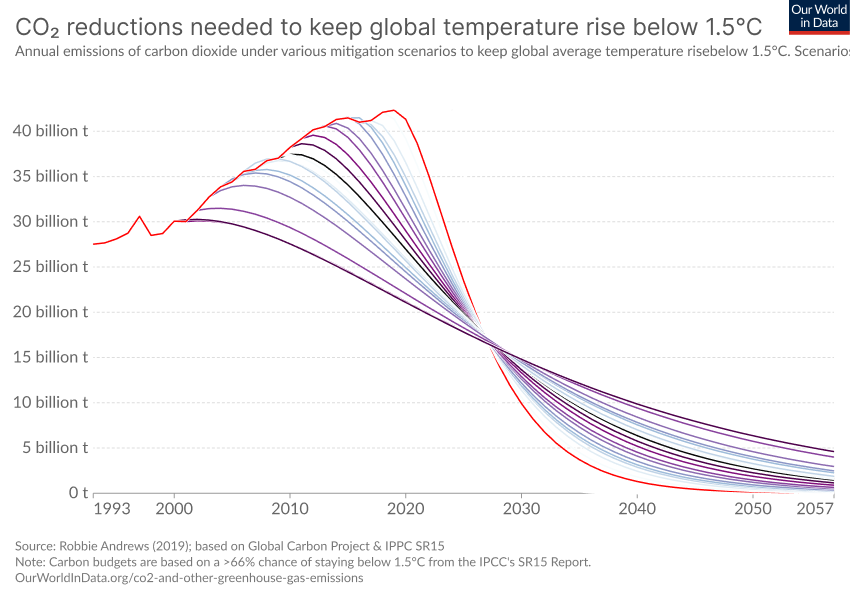
Clearly, if we’re to have any chance of keeping the planets tempurature within safe limmits, we need to take big steps right now to start drastically cutting our emissions. We can all play a roll in this. Did you know that for the average British holdhold, the emissions caused by how their bank investsts their savings can cause more CO2 emissionsn than a return flight to New York? Switching your money to a provider that doesn’t invest in fossil fuels, tracking your footprint and making smart switches to reduce it can all help you play your part by cutting your own carbon footprint. Try Tred now to get started.



0 Comments