

Who you bank with can have a big impact on your carbon footprint, because your money could be funding destructive fossil fuel projects or backing green infrastructure and renewable energy, depending on the choice you make. In total, the worlds 35 biggest banks, many of which are UK high street banks, have provided $2.7 trillion to fossil fuel projects since the Paris Agreement in 2015.
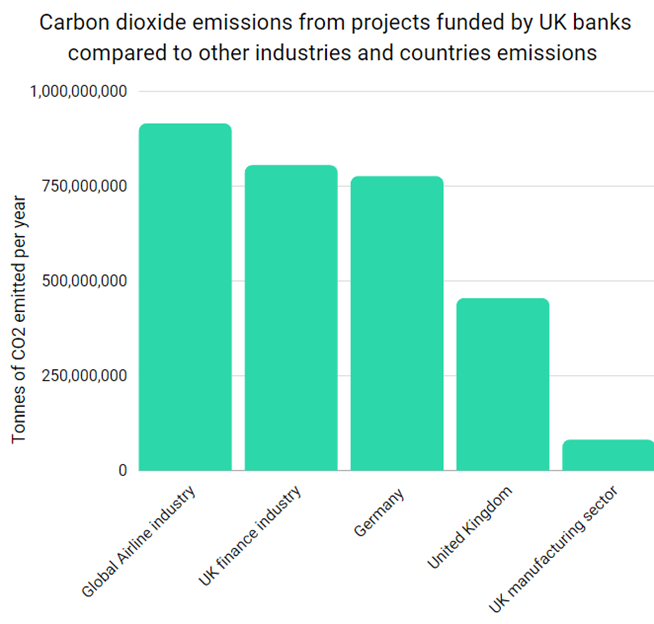
The fact that the emissions of projects backed by UK banks are double the emission of the entire rest of the country starts to give you some idea of how big an impact on your carbon footprint your financial choices can make.
A study by Greenpeace and WWF found the UK finance industry was responsible for 805 million tonnes of CO2 emissions each year, more than the entire country of Germany, and similar to the entire global airline industry. Switching to a more sustainable model clearly should be a big priority.
Here at Tred we’re on a mission to make money work for people and planet. That’s why we’ve created our app & Tred debit card to let you see your carbon footprint in real-time from your spending and plant trees as you spend.
You can store your money safely with Tred and spend on your Tred card, but Tred is not a bank. That means for now at least, if you use Tred (which we sure hope you do) you’ll have a Tred account which you move funds to and use for your day-to-day spending on your card, but you’ll also keep your bank account for things like paying direct debits. You’ll still be able see your carbon footprint across the whole range of your spending if you hook up open-banking, but we recognised that until Tred can do every single thing your bank can do, you’ll likely retain a bank account alongside your Tred account.
That means you’ll still have a current account with a UK bank. So, if you want to ensure your money is working for the planet, or at least not actively funding fossil fuel companies and other environmentally dangerous activities, you’ll want to pick a current account that’s among the most sustainable available in the UK.
To help inform your decision, we’ve created a list of the best choices. One thing to keep in mind when your researching the eco-credentials of your bank is that on average banks produce 700 times more emissions from their loans than they do from their offices, so it’s not just important to consider how sustainable the business runs it’s own offices, but also what it is investing your money in.
Triodos Bank
Triodos are a certified B-corporation, and one of the world’s most sustainable banks. Their transparency is excellent, as they publish details of every organisation they finance on their website, so you can be confident your money isn’t funding climate destruction.
They do however have a £3 per month fee for their current account, so if you’re after a bank that offer a free current account you’ll need to look elsewhere. They also don’t do credit cards, personal loans or mortgages so you’ll need to think about what other sustainable options there are for your finances.
The Co-operative Bank
The Co-operative Bank have been operating as an ethical bank for 150 years, and as well as being ethical they also take being environmentally sustainable seriously. As an organisation they’ve pledged to be carbon neutral and send zero waste to landfill, and have been given the best ESG (Environmental, Social and Governance) rating of any UK high street bank, and crucially they don’t invest in fossil fuels.
But that’s not the entire picture. The Co-operative Bank may not invest directly in fossil fuels and un-ethical activities like arms sales, but it is owned primarily by a number of US hedge funds which are not ethically or environmentally minded in their investment policies. Given the profits of the Co-operative bank will flow to its shareholders, which are mostly US hedge funds, if you’re concern about how your money is invested ethically then you’ll want to consider this.
Nationwide
Nationwide is a mutual society, which means it is run for the benefit of it’s members rather than shareholders. They are a member of the net-zero banking alliance and say they have no appetite to invest in fossil fuels. They’ve been carbon neutral for their operational emissions since April 2020, using only 100% renewable electricity and offsetting what emissions they could not reduce. They offer current account as well as credit cards, loans, mortgages so if you’re looking for a sustainable place to choose for all your financial services, they could be a good choice.
The Charity Bank also deserve a shout out here as a bank dedicated to doing good, but they don’t offer current accounts, so we couldn’t include them as an option in this round up.
All in all, the lack of options for a sustainable bank in the UK is rather surprising. There are a range of ethical banks in the UK, but none with the tackling climate change as the core of their mission. So by all means choose a more ethical bank to help the climate by keeping your money out of fossil fuel investments, but remember it’s also worth getting Tred so you can plant trees as you spend and have your carbon footprint at your fingertips.




0 Comments